944th FW joins forces for life-saving mission after Hawaii fireworks explosion
In the predawn hours of New Year’s Eve, a deadly fireworks explosion in Hawaii sent shockwaves across the islands. Three people tragically lost their lives and 20 more were injured. Six survivors were airlifted aboard an Air Force C-17 from Joint Base Pearl Harbor-Hickam, Hawaii to Phoenix, Arizona, Jan. 4, where they would receive specialized care at Valleywise Medical Center’s renowned burn unit.
The mission to safely transport these patients, over extensive distances, was a joint effort between the Air Force Reserve’s 944th Fighter Wing, the active-duty Air Force’s 56th Fighter Wing, the Phoenix Fire Department and civilian medical professionals.
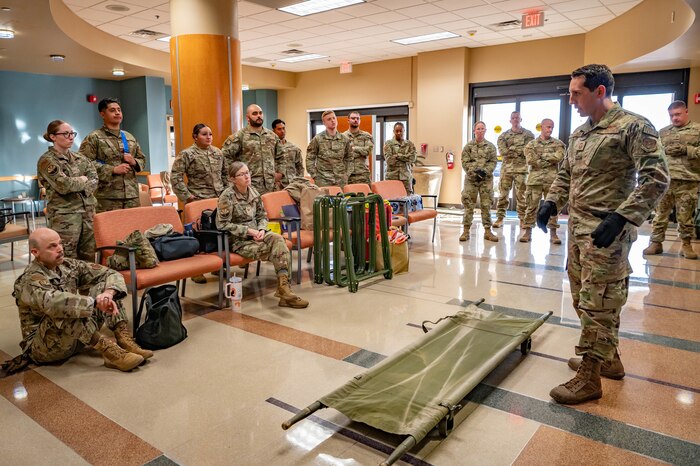
“This is what we train for, and when the call comes, we’re ready,” said Capt. Paris Mandy, a clinical nurse with the 944th Aeromedical Staging Squadron.
With their core mission centered on patient movement and stabilization, the 944th ASTS played an instrumental role in this high-stakes operation. From the moment the team was activated, members worked side by side with active-duty Airmen and civilian counterparts to ensure mission success.
Mandy described the mission as a real-world scenario where the unit’s extensive training could be directly applied.
“Today, we’re not working with mannequins. These are real patients who need us,” Mandy said. “It’s both humbling and exhilarating to put our skills to work in such a meaningful way.”
For some of the Reservists, including 944th FW ASTS Master Sgt. Elisabeth Yates, this was their first real-world operation.
“This is why we train so rigorously,” Yates noted. “When you’re called at a moment’s notice, readiness is everything. This mission brought all our preparation into sharp focus.”
Yates highlighted the critical role Exercise Desert Hammer 25-1, a rigorous annual training exercise con-ducted by the 944th FW in November, played in preparing them for this moment. The exercise simulates high-pressure, real-world scenarios, requiring rapid adaptability and flawless execution.
“Desert Hammer taught us how to operate at a real-world pace,” Yates added. “That training translated directly into our ability to respond effectively today.”
The joint nature of this operation was a testament to the power of collaboration. Capt. Eric Huff, 56th FW Medical Group Director of Tactical Combat Casualty Care, emphasized the importance of teamwork in ensuring patient safety.
“We had to transfer patients from military litters to Phoenix Fire Department gurneys, which required precise coordination,” Huff explained. “It’s not just about physical strength – it’s about communication and synchronization among all teams involved.”
The mission also highlighted the human element at the heart of military operations. For 944th FW ASTS Staff Sgt. Nathan Espinoza, the experience was profoundly meaningful.
“Helping people who can’t help themselves – that’s why I joined,”
Espinoza said. “Seeing the resilience of these patients and knowing that our efforts are making a difference is incredibly rewarding.”
